
Waller Creek Software builds systems for companies across Travis, Williamson, Hays, Bastrop and Caldwell counties. Our deepest work is in healthcare, manufacturing and sales, and we build for every other industry too. You work directly with co-founders Taylor Moses and Jamison Dyal, from the first conversation through launch and the improvements that follow.
Five signals your Austin team needs its own system
You do not need custom software because a competitor has it. You need it when the way you work has become an advantage that off-the-shelf tools keep flattening. These are the signals we hear most often in early conversations.
- The same customer, patient or order is typed into two or more places.
- Your best process lives in one person's head or one person's spreadsheet.
- Leaders find out about problems after the customer does.
- You pay for features you never use and still work around the ones that are missing.
- Reporting means exporting, pasting and hoping the formulas held.
When building beats buying, and when it does not
If two or more of those signals sound familiar, custom software development for your Austin business is worth a serious look. If only one does, a smaller fix such as an integration or a single internal tool may be the better first move, and we will tell you so.
A good test is to ask what makes your company different from the next one in your field. If the answer is a process, a service promise or a way of handling customers, generic software will push you toward everyone else's process. A system built around that difference protects it.
On the other hand, if your needs match what a mature product already does well, such as standard payroll or basic email, buying is usually the smarter call. We would rather help you spend money where it changes something.
- 1 Understand the work
- 2 Map the system
- 3 Build the first release
- 4 Use it for real
- 5 Extend it
Healthcare: HIPAA compliance from the first screen
Healthcare is where we are most careful, because the stakes are higher. Austin has a deep medical community, from Dell Medical School and Dell Seton Medical Center downtown to St. David's, Ascension Seton and Baylor Scott & White in Round Rock. The practices and healthcare companies around them need software that respects patient privacy without slowing staff down.
Every healthcare system we build is fully HIPAA compliant. We sign BAAs and any other compliance agreements you need, and a HIPAA-trained team member is involved in the build. We have also built advanced audit trails and full systems for FDA-regulated work under 21 CFR Part 11.
- Patient intake that arrives complete before the visit
- Referral tracking that shows where every referral stands
- Patient portals for forms, messages and documents
- Practice management and reporting for the front office
- Connections to EMR and EHR systems where the vendor's APIs or integration options allow
✕Customer details retyped into three different tools
✓One record that every team reads from
✕Problems discovered after the customer calls
✓Exceptions flagged early so leaders act first
✕Commissions calculated in a spreadsheet at month end
✓Commissions triggered when contracts are signed and paid
✕Paying for features nobody uses
✓Only the features your team actually needs
✕Status updates assembled by hand
✓Live views by role, ready when someone asks
Manufacturing: one thread from quote to service
Central Texas manufacturing keeps growing, with semiconductor work like Samsung in Taylor and Tesla Giga Texas in southeast Travis County drawing suppliers and service companies into the region. Many of those smaller firms still run quoting, production, inventory and field service in separate tools that never quite agree.
Our Industrial Operations Platform shows the alternative. We built a quote-to-service operating system for a private industrial company, so a quote becomes a job, the job draws on inventory, quality checks attach to the work, and service history stays with the customer. Leaders manage by exception: the system surfaces what is late, short or out of spec, and everything else keeps moving.
That is what custom software development looks like for a plant in Austin or Pflugerville: fewer handoffs, fewer phone calls asking where things stand, and one place to look.
Sales: a CRM that keeps going after the signature
Sales teams come in every shape: inside reps in an office near the Domain, remote reps across the state, door-to-door crews working neighborhoods in Cedar Park and Kyle. Generic CRMs tend to lose interest once a deal closes. Your business does not.
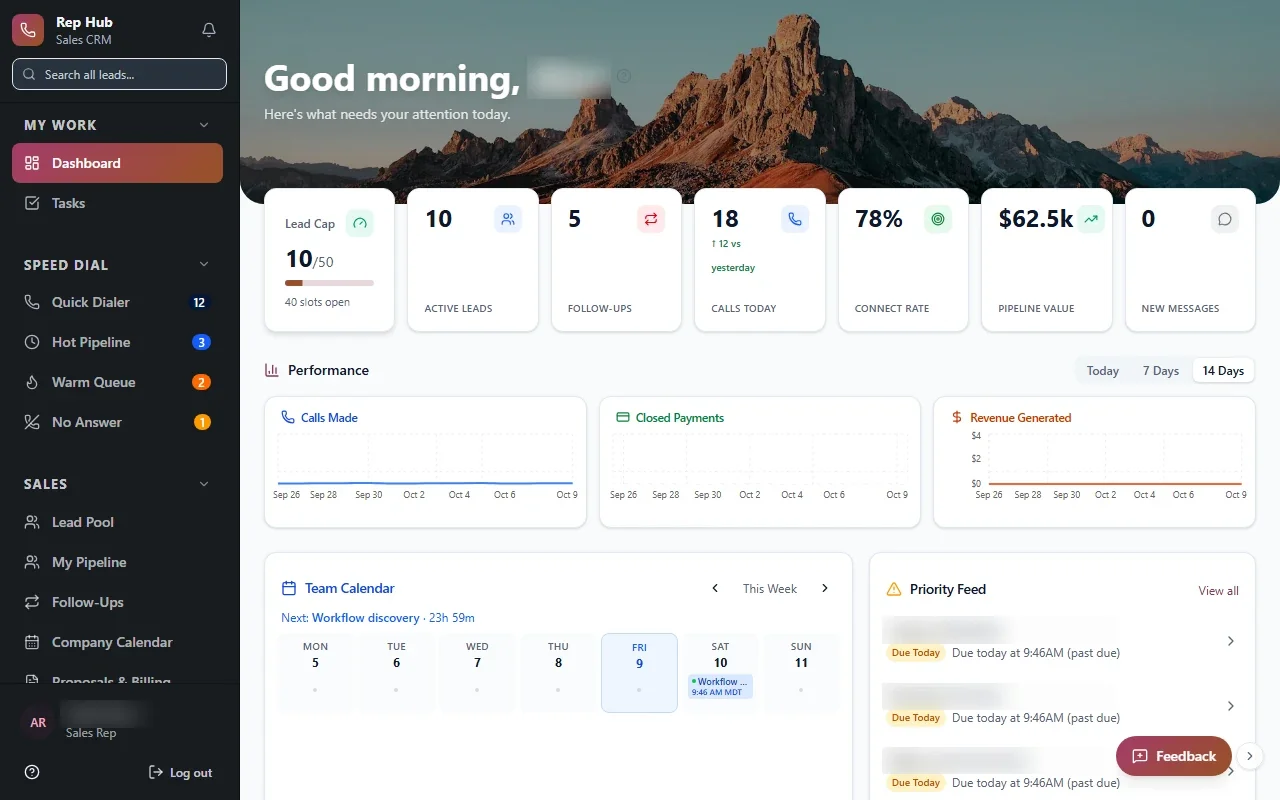
Rep Hub, a sales platform we built, covers the whole rep lifecycle. It handles recruiting and training, gives each rep a workspace, and manages contracts. When a contract is signed and paid, the system triggers delivery and calculates commissions, so nobody chases a spreadsheet at month end.
- Commission rules written the way your comp plan actually works
- Training paths new reps can finish between appointments
- Territory and lead views for managers in the field
The system handles
- Assigning the next step
- Reminders and follow-ups
- Status updates between teams
Your people decide
- Judgement calls and approvals
- Customer conversations
- Exceptions that need a person
Discover, Design, Build, Launch, Optimize
Every project follows the same five stages, and each one ends with something you can review and approve.
- Discover: we sit with the people doing the work and map where time and information get lost.
- Design: you click through screens and flows before code, and we agree on the first release.
- Build: you test working software as it comes together, instead of waiting for a demo at the end.
- Launch: we move real data, train your team and switch over with a plan.
- Optimize: we watch how the system is used and improve what matters most.
Security, ownership and confidentiality
Keeping the first release focused is how custom software development stays manageable for Austin teams. It solves one painful problem well, so your people get value early and the next round of work is shaped by real use instead of guesses. Across 20+ custom systems in 9+ industries, that habit has mattered more than any single feature.
You own the code and the data. If you ever want to bring development in house or work with someone else, nothing is held back.
Security is built in from the start: encryption, multi-factor authentication, role-based access and monitoring are standard parts of our builds. Most of our work is under NDA, which is why you see project names here rather than client names. When you choose custom software development from an Austin company, you should know exactly who can see what, and who owns the result.